METR's task-completion time horizon measures two things: how long a human takes to do a task, and how often a model can successfully accomplish that task. When people share METR graphs suggesting that models have a 4-hour time horizon, it means that for tasks that (relatively) expert humans take 4 hours to do, models can succeed 50% of the time. This is useful for tracking frontier capabilities and AI safety, but it doesn't show how AI is changing day-to-day workflows.
Another measure is how long an agent runs before you have to step back in — call it time to user engagement. I expected that window to grow as models improved, but live session traces point the opposite way: median sessions are getting shorter and shorter!
Raw wall-clock duration isn't the same as task difficulty. Monitoring a training job and restarting it if it goes down takes a long time while staying simple for a model; defending against an active DDoS attack via a runbook is hard and fast. Still, pairing duration with throughput, merge outcomes, and how tasks are delegated lets us see what models actually handle autonomously today — and how to get the most out of them.
Methodology
risenlab/agentlogs (RISEN Lab, arXiv:2608.29204) is an open dataset of 635,886 asynchronous cloud coding agent sessions on public GitHub repositories from May 2025 through September 2026, spanning 353,432 distinct tasks and 317,878 pull requests.
Unlike PR-only scrapes, it joins task metadata, PR merge outcomes, and GitHub Actions workflow runs to step-level execution traces (individual LLM calls, tool invocations, token counts, and timestamps).
To build the dataset, the authors started from a seed list of public GitHub repositories with more than 10 stars and fetched session metadata and raw step transcripts from GitHub Copilot's cloud-agent API (api.githubcopilot.com).
Every run executes as an asynchronous background job — you assign work, wait, and review the resulting PR.
A few definitions carry through the charts below:
- A task is a single issue or PR thread that may span multiple sessions (
session_index = 0is the initial run;session_index ≥ 1are follow-up steering sessions). - Every session carries a trigger event (
event_type) capturing what kicked it off: delegated tasks (fresh tasks handed off via issue assignments or chat), PR follow-ups (PR review comments and post-session steering), CI fixes, and automated review requests. - A 1-shot merged PR is a task completed in a single session whose PR merged without follow-up steering, while cancellations capture runs stopped before completion.
For the analysis below, we focus exclusively on delegated tasks.
This subset contains 200,631 sessions (31.6% of the dataset) spanning 172,231 pull requests.
We filter out short PR review comments, automated review-request bursts, and CI-repair jobs to isolate fresh tasks handed off to run autonomously until PR review.
For Section 2's throughput and active-turn measurements, we use all 196,987 delegated-task sessions with step-level logs (159,400 with complete token telemetry, covering runs through May 2026 before token counts stopped being logged).
Analysis
1. Shorter wall-clock times, higher 1-shot completion
Across delegated tasks, median wall-clock duration peaked in late 2025 and then more than halved over the following year.
Upper-tail (p90) duration barely budged over the same period, holding steady in the mid-to-high 20-minute range.
Shorter runs did not come at the expense of quality.
Both single-session completion and 1-shot PR merge rates climbed through late 2025, plateaued through spring 2026, and stepped up again in summer 2026 as newer frontier models ramped up, while cancellations trended down.
(The apparent dip in Sep 26 merge rate is an artifact: late-window PRs had less time to be reviewed and merged before the dataset cutoff.)
2. Increased throughput reduces wall-clock times
Serving speed roughly doubled across Anthropic model generations on delegated tasks.
Opus 4.5(21.1 tok/s) →Opus 4.6(33.8 tok/s) →Opus 4.7(43.2 tok/s)Sonnet 3.7(17.3 tok/s) →Sonnet 4.5(23.9 tok/s) →Sonnet 4.6(36.4 tok/s)
Across turn-level traces, faster inference compressed active session duration on Anthropic models, and on the newest generations (Opus 4.6 → 4.7 and Sonnet 4.5 → 4.6) that speedup compounded with fewer LLM steps and lower output token volume (18.8k → 13.7k and 15.9k → 13.6k).
Earlier jumps (Opus 4.5 → 4.6 and Sonnet 3.7 → 4.5) emitted more output tokens, which partially offset or outweighed throughput gains.
OpenAI models show a similar efficiency shift: shorter runtimes on GPT-5.3-codex and GPT-5.4 came primarily from lower token volume rather than higher serving throughput.
(Because token telemetry stopped being logged after May 2026, this breakdown covers the compression through spring 2026 rather than the newer summer 2026 models in Section 3.)
3. Model comparison on controlled delegated tasks (Aug–Sep 2026)
Pooling across all 16 months mixes together platform upgrades, prompt-template changes, and different model eras.
To compare models within the same platform window, we restrict to Aug–Sep 2026 initial delegated tasks (11,360 tasks across 12 models).
This controls for calendar time and harness changes, though not for user-driven model routing (developers may still assign harder issues to frontier reasoning models and simpler fixes to faster defaults).
On this controlled slice, models separate cleanly in both their typical runtime and their right-skewed tail.
Frontier reasoning models (GPT-5.6-sol, Opus 5) stretch both the interquartile range and upper tail far beyond faster, shorter-horizon models like GPT-5.3-codex and GPT-5.4, while MAI-1.1-flash stays short at the median yet exhibits a long upper tail.
The survival curves make this tail separation clear: GPT-5.6-sol and Opus 5 keep a substantially larger share of runs active past 15–30 minutes than Sonnet 5 or GPT-5.3-codex.
Near the far end, all models converge toward the platform's ~60-minute timeout ceiling.
Duration alone does not distinguish productive persistence from thrashing.
Partitioning initial tasks into mutually exclusive outcomes shows that GPT-5.5, Opus 5, GPT-5.6-terra, and Sonnet 5 ship clean 1-shot merged PRs at nearly twice the rate of GPT-6-astra (which suffers from elevated failure rates) or GPT-5.4.
GPT-5.6-sol trades longer runtimes for a slightly higher rate of cancellations and failures.
| Model | Tasks | p50 |
p90 |
Steps p50 |
1-shot PR (all) | 1-shot PR (if PR) | Multi-sess | Cancelled | Failed |
|---|---|---|---|---|---|---|---|---|---|
claude-opus-4.8 |
272 | 8.6m | 27.9m | 38 | 34.6% | 53.4% | 36.0% | 2.2% | 3.3% |
claude-opus-5 |
1,061 | 11.2m | 35.0m | 42 | 46.6% | 60.1% | 22.7% | 1.8% | 4.2% |
claude-sonnet-4.6 |
1,618 | 4.7m | 22.7m | 26 | 39.4% | 51.5% | 27.7% | 2.0% | 1.5% |
claude-sonnet-5 |
1,192 | 8.5m | 24.3m | 42 | 45.2% | 62.4% | 23.7% | 1.7% | 1.3% |
gpt-5.3-codex |
2,116 | 5.0m | 18.2m | 31 | 33.0% | 47.0% | 28.8% | 3.4% | 2.3% |
gpt-5.4 |
1,285 | 5.8m | 16.0m | 34 | 28.8% | 44.2% | 28.3% | 3.1% | 3.5% |
gpt-5.5 |
652 | 11.2m | 28.0m | 40.5 | 50.5% | 59.9% | 17.3% | 2.0% | 4.5% |
gpt-5.6-luna |
593 | 6.6m | 19.3m | 36 | 30.7% | 49.2% | 29.0% | 3.2% | 1.4% |
gpt-5.6-terra |
882 | 8.6m | 23.0m | 34 | 45.9% | 59.8% | 20.0% | 1.5% | 3.4% |
gpt-5.6-sol |
1,240 | 13.1m | 40.1m | 58 | 38.4% | 53.9% | 27.3% | 2.4% | 5.2% |
gpt-6-astra |
299 | 10.9m | 31.8m | 62 | 25.1% | 35.9% | 35.5% | 1.7% | 19.7% |
mai-code-1.1-flash |
150 | 6.5m | 32.6m | 28.5 | 28.0% | 40.6% | 30.7% | 4.7% | 2.7% |
4. Entry-point heterogeneity within delegated tasks
Even within delegated tasks, which GitHub UI kicked off the run strongly shapes both runtime distributions and abandonment.
Formal issue assignments (issues_agent_assignment, issue_assignment) run the longest and are rarely cancelled, whereas dedicated interactive surfaces (agents_page, immersive_page) see far higher abandonment and much shorter lower tails.
Meanwhile, repo_agents and copilot-chat-spec-task finish faster on average while maintaining strong PR merge rates.
Because these newer surfaces run roughly half as long at the median as formal issue assignments, shifts in entry-point mix also contribute to the aggregate runtime decline in Section 1 alongside faster models.
Discussion
With minimal prompting and a rough goal, models like Gemini Neon and Fable 5.2 can already run productively for tens of minutes on their own.
In aggregate, however, models are NOT being used for longer autonomous runs. Through a mix of increased inference throughput, more efficient step and token usage typical sessions are getting shorter.
Anthropic's economics team did an analysis comparing how models augment versus automate workflows.
These traces show a split picture: rising single-session completion (44% → 74%) and 1-shot PR merge rates (15% → 58%) indicate that end-to-end automation of bounded tasks is getting both faster and more reliable.
At the same time, the scope of work engineers delegate to cloud agents hasn't expanded.
Developers are mostly automating small, well-scoped PRs inside an augmented workflow rather than handing off open-ended epics.
As shown in Section 3, longer runs are no guarantee of higher success.
Opus 5 and GPT-5.5 convert longer runtimes into strong 1-shot merge rates, whereas pushing further on GPT-5.6-sol and GPT-6-astra brings more cancellations and failures rather than better outcomes (likely reflecting thrashing and long-context limits).
Consider xkcd #1205 ("Is It Worth the Time?"):
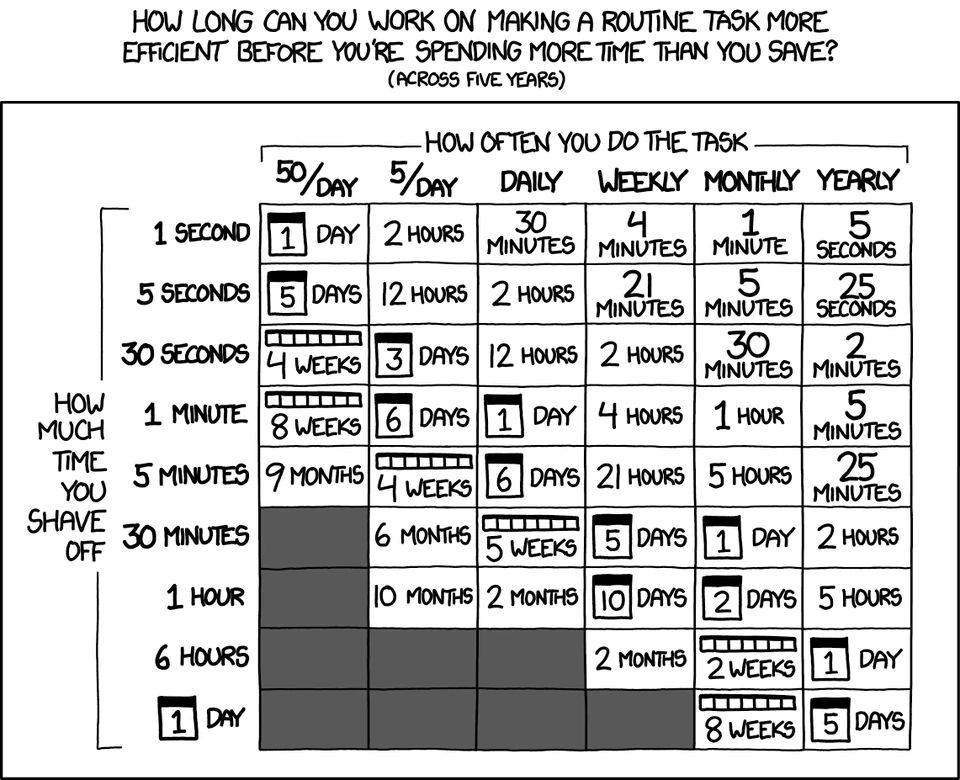
Reliable 30+ minute async agents would collapse the cost of many tasks down to spec time + review time + retry risk. That flips huge swaths of work from "not worth automating" to "obviously worth delegating." For example, how many hours have been lost on overnight training runs getting interrupted or killed for one reason or another? Far too many!
Routine delegated PRs are getting faster at the median, while the upper tail on frontier reasoning models is crossing the threshold where you CAN delegate tasks to models for longer stretches. Looking at these logs (and data from OpenAI), models are starting to run reliably enough on their own that you can context-switch back to work that demands your focus.
Caveats
- Platform timeout ceiling: GitHub Actions execution limits cut off long runs around 60 minutes, right-censoring the extreme upper tail of uninterrupted runtime.
- Model-routing selection bias: Slicing Section 3 to Aug–Sep 2026 controls for calendar time and platform changes, not task difficulty; users may route harder issues to frontier reasoning models and quick fixes to faster defaults.
- Entry-point mix shift: Newer delegation surfaces (
repo_agents,copilot-chat-spec-task,immersive_page) have much shorter median runtimes than formal issue assignments, so changes in surface mix contribute to the aggregate decline in Section 1. - Token telemetry cutoff: Token counts stopped being logged after May 2026, so Section 2's throughput-vs-volume analysis does not cover the summer 2026 model releases in Section 3.
- Sample selection:
risenlab/agentlogscaptures public GitHub repositories (>10 stars) using GitHub Copilot's cloud agent, which may differ from private enterprise codebases or interactive local IDE agents.
Cite this article
@misc{nguyen2026agentautonomy,
  title={Cloud Coding Agent Autonomy in the Wild},
  author={Tommy Nguyen},
  year={2026},
  publisher={nwyin.com},
  howpublished={\url{https://nwyin.com/agent-autonomy/}},
}TY - GEN
AU - Nguyen, Tommy
TI - Cloud Coding Agent Autonomy in the Wild
PY - 2026
DA - 2026/11/23
PB - nwyin.com
UR - https://nwyin.com/agent-autonomy/
ER -