Contents
I have easily spent tens of thousands of hours playing video games. I've dedicated years and years to playing all sorts of games – board games, strategy games, shooters, rhythm games, puzzle games, RPGs, on and on and on.
I got fairly good at a few of them. In two games in particular, League of Legends (a MOBA) and Teamfight Tactics (an auto chess game), I was ranked around the 98th–99th percentile. I didn't concentrate on any other games in particular, but managed to be a little above the 50th percentile in most games that had some kind of competitive ranking system.
I am not a champion. I'm not even great – only "decent." But I've spent a lot of time thinking about what lessons I learned while playing games that I've been able to extend to the rest of my life. Perhaps it's cope. Maybe I'm trying to justify many wasted hours (and there were many wasted hours indeed!)
playing to win
Zero-sum, competitive games teach you to win. They teach you to want to win.
Success in any zero-sum competition means having to beat other players who want to win just as much as you. Actually, many of them will want to win more than you.
Games are a low-stakes way to experience this dynamic, where you face people who are willing to do nearly anything to win. In tournaments, especially. Tournaments define formats and provide a strict, clear (and usually concise) set of illegal moves. Everything else is fair game.
In life, the stakes in any extremely competitive field can be higher (or at least feel higher). Not being admitted to a program with a finite class size, not attaining a job position, or not winning the attention of someone you'd want to marry — all of these are incredibly high-stakes losses.
And the competition is fierce. For many desirable careers, you will be competing against talent from all over the world. Competitive players from all developed economies will want the same positions at top companies, and dark horses from unexpected places will overcome all kinds of adversity to outcompete too.
—
Games can teach you if you're fit for this environment or not. Not everyone wants to win in finite, zero-sum games. Not everyone should want to play and win these games.
But many people do not have enough experience in these high-octane environments, surrounded by people who truly want to win. How would you ever find out you liked these environments until you experienced them yourself a few times?
Competition comes in many flavors, and the different communities and cultures of games are a quick way to sample many of them.
what makes a champion
David Sirlin (world class Street Fighter 2 player) wrote a book titled Playing to Win. He writes about the psychology of top games players based on his own experience and his relationship with other top players in the field. He drafted the following list of traits that seem to define top players:
- familiarity with tournaments
- deep knowledge of the game
- love of the game
- mental toughness
- "growth mindset/grit", not discouraged by losses
- technical ability
- adaptability
- knowledge of other games in the same genre
- "yomi"
- "appraisal"
Based on my own experience with competitive games playing, I think that some qualities are more important than others. Some qualities are also more "trainable" and applicable to domains outside of games. Those are the ones I want to discuss.
- endurance
- technical ability
- "appraisal"
- "acuity"
- "yomi"
endurance
Becoming world-class is a long-term endeavor. No one is an overnight success in highly competitive fields, even those with the most innate talent.
Some other qualities that might correlate with endurance might be: high pain tolerance, low neuroticism, high conscientiousness, high desire (greediness), highly motivated.
Endurance can come from many sources. Some people are just "built different."
In life, I don't think it quite matters where your source of endurance comes from. But it's a necessary component to world class performance.
technical ability
Execution is the moat. In an information age with many billions of people, secrets are hard to keep. It's likely someone else will independently discover the same "secret" that you've found. Unless you truly have some reason to believe you can keep your secret forever (maybe a literal, physical, geographical moat), then you should be suspicious that someone will (or already has) discovered what you know.
Thus, execution matters. The defining thing for many world class performers is that they "execute." More importantly, that they're able to execute consistently, under high stress or unfavorable positions.
Competitors do not care if you are depressed, tired, injured, or old – they want to win as much as you do.
Winners are defined by their ability to execute no matter the conditions.
This is why endurance and practice are key. Taking action must become muscle memory. You have to be able to trivially and automatically perform the sequence of moves to win.
appraisal and acuity
Sirlin describes appraisal like so:
the ability to judge the relative value of different tactics and strategies of the game
He goes on to describe that there are two kinds of appraisal. There's understanding the overall game (e.g. strategy), and understanding the specific situation and optimal actions to take in that specific situation (e.g. tactics).
A more precise term for the second kind of appraisal is "acuity" – or in essence, the ability to appraise more accurately and quickly.
Appraisal is understanding the game. Acuity is understanding this game.
For example, take no more than five seconds to think about this question: who is better in this position, White or Black? And why?
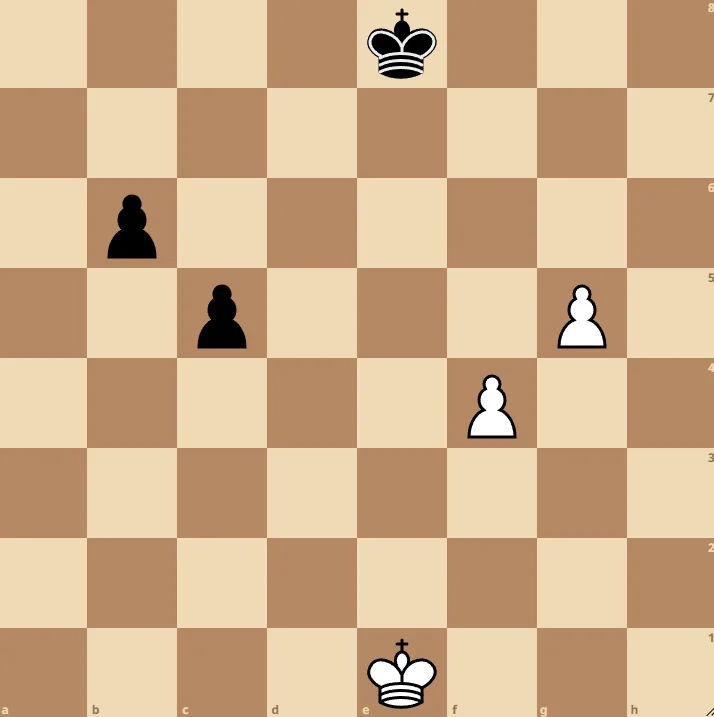
Trick question, it's neither! This position is a draw.
A grandmaster chess player would've known this from the moment the photons of this image hit their retina.
Appraisal is understanding that this board position is a draw. Acuity is knowing that within milliseconds.
Recently, Magnus Carlsen (known as the greatest chess player in history) has said that long time formats do not judge who the best players are anymore. In a world of chess engines, any reasonably talented child can remember enough opening lines and principles to become world class. Chess, due to its long history and engines, has become a "solved game." Long time formats no longer judge appraisal ability in the same way.
It's perhaps why Carlsen and other grandmasters are moving towards shorter time formats. Appraisal ability has become commoditized. What makes a champion is "acuity" – or a player's ability to understand the board position within seconds. (Carlsen is also pushing for competitive and professional play of chess variants, which have existed for a much shorter time. There are fewer engines that can play variants well).
"yomi"
Is the Japanese kanji for "reading" – as in "onyomi." It's slang in the fighting game community for "mind reading."
In adversarial games, predicting your opponents' moves naturally sets you up to win. In games where there is no "optimal strategy" to draw, or where execution ability can determine winners and losers (e.g., faster reaction time), "yomi" will be a differentiator.
There are usually "perfect counters" to every move a player can take. The play, in a vacuum, may be suboptimal. But it also might be the perfect play in that particular situation.
Yomi is most visible as a differentiator in games with imperfect information (like poker). Individual players should not know the cards in each other's hands. But a player gifted with yomi will just "feel" it – they will know if their cards are better or not, or how other players will react to their moves.
It's generally a bad strategy to bet all your chips in poker. The single turn can knock you out of the game. But poker champions know when everyone else will fold (regardless of their card values).
in the real world
A lot of pop-psychology has been published about why "grit" is important for success. It's also clear that technical execution matters a lot in the world. No one wants an incompetent car mechanic or doctor.
What's less obvious is how appraisal, acuity, and yomi affect life. I argue that these traits only really matter at the highest level of play.
There's a dynamic in video games where many players can reach ~98% skill ranking based on playing a long time and developing technical execution ability. In a variety of strategy games, fighting games, and other genres, there is a phenomenon of "one-trick ponies."
These players dedicate themselves to a single strategy and a finite set of tactics that the strategy affords them. This might look like only playing a single character (popular in Japan, as there are many tournament formats where you register with a character upfront and you are only allowed to play that character for the tournament).
Outside of games, this might look like "tiger parenting." A common thing in immigrant American families is to encourage their children to focus on "safe" and popular career paths. Become a doctor, lawyer, or engineer and focus on strategies to get admission to top programs. In a sense, all these students are STEM "one-trick ponies" – taking a single strategy in life and optimizing within that ruleset.
Many people reach great life outcomes with this strategy. It's why it's still a common strategy. Succeeding in this strategy guarantees you a 90th percentile outcome. You end up attaining levels of education and income that a majority of the world will not have access to.
But it's very hard to become world-class by doing this. I don't know of many 99th+ percentile performers who only optimized technical execution.
–
Appraisal and acuity matter a lot near the top. For 99th+ percentile outcomes, you must understand "the game" and understand it quickly.
For example, most fields require specialization. It's one thing to want to be a lawyer/doctor/engineer – but what kind of lawyer? What kind of doctor? What kind of engineer?
Choosing to be an aerospace engineer 20 years ago might've landed our engineer a position at Boeing or Raytheon, working on projects that went over budget and ultimately failed. If instead, they chose to be a software engineer, they had good odds at landing a role at any of the tech giants we know today. Here, appraisal ability mattered. Did our hypothetical engineer understand the "engineering game"?
Or, say they REALLY loved aerospace and wanted to work on aerospace no matter what. When SpaceX was founded in 2002, were they excited at the prospects, or did it never occur to them to consider working there?
Appraisal is about judging the relative values of decisions you can make. It's common to talk about it as "intuition" or "gut feelings" but some people consistently make better decisions than others. It's worth understanding how those people make decisions; how they judge the relative value of their decisions. Appraisal ability is teachable.
—
In some sense, yomi is about understanding your relationships. Are the people around you allies or enemies? Do you know what they're going to do, even before they know it?
In startups and businesses, early partnerships and hires matter a lot. It's just my speculation, but I would guess that many businesses could avoidably fail just by choosing better candidates for the job.
This is perhaps why some of the most successful venture capital funds and grant givers prioritize evaluating the candidate, not the project. You can assess someone's technical ability just by their track record. Anyone who's completed a PhD and published papers in the past, or a software engineer who's delivered projects at a tech company have some baseline level of technical competence. But how can you evaluate if a project will succeed or not? Especially if multiple people apply with the same idea?
Funders have to evaluate these less legible, "personality traits" of the fund receiver. They have to understand their motivation, how conscientious they are, what they'll actually do with the money they give them.
Of all the traits that make a champion, yomi is the least teachable. I'm uncertain whether it can be taught at all (Sirlin mentions this as well). Some people seem to truly have a sixth sense for judging people.
completeness hypothesis
I've seen the most salient description of this idea come from Samo Burja in his draft of Great Founder Theory:
having all of the important contributing pieces to producing an effect makes a given effect much, much larger than having most of the pieces. Having 100% of the pieces of a car produces a very different effect than having 90% of the pieces.
Alexey Guzey also has a great point about this in his blog post titled Why Is There Only One Elon Musk?
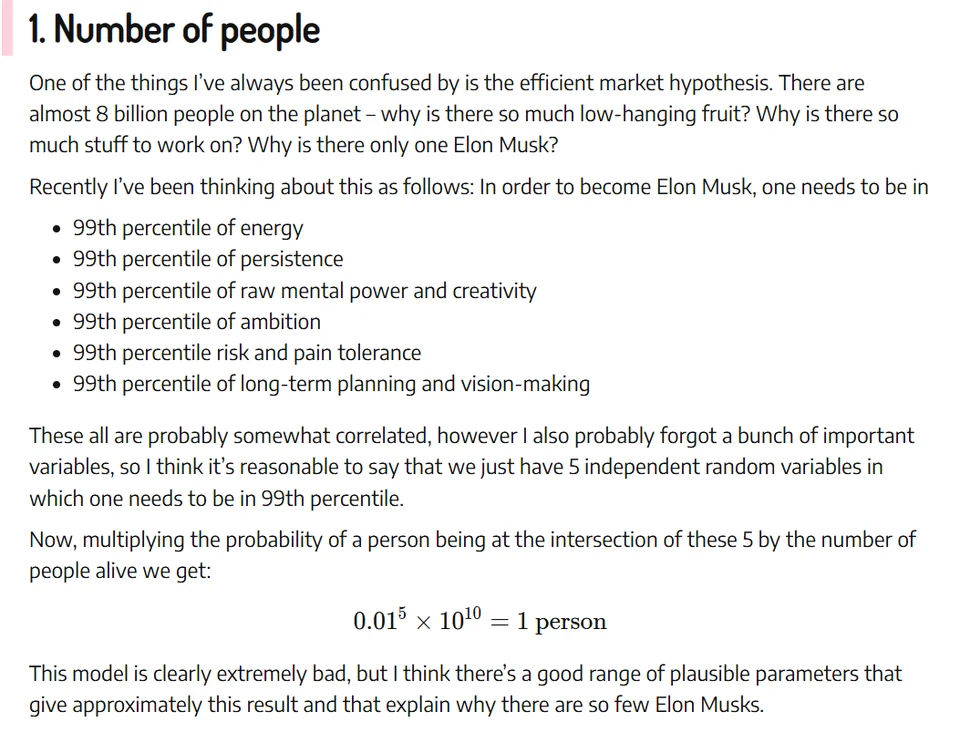
Becoming world class is rare and hard. Not because any individual skill or talent you need to become world class is hard to develop, but because you must have all of them.
I know of many people who quit too early. I myself have probably ruled myself out of many "world class" performances by quitting too early. This is why endurance is a necessary, but not sufficient, quality for many top performers. You must have the mental toughness to endure the abuse and imbalance of a world class performing lifestyle. You must be able to push through hours of practice to develop the requisite technical ability.
You also must have good judgment. And in certain contexts, you must make good judgments fast. This matters even more at the top levels, for faults in your judgment can make or break your performance (e.g., in a negotiation).
And in the most competitive fields, you are not the only player. You need to be able to assess and predict the actions of other people or firms. Otherwise, you will simply be outcompeted.
winning in life
There are at least two kinds of games. One could be called finite; the other infinite. A finite game is played for the purpose of winning, an infinite game for the purpose of continuing play. – James P. Carse
—
Many common goals have the following structure:
1. A difficult, finite game, followed by
2. An easier, infinite game.
Finding and getting married to the right person is much harder than staying married to the right person, for example. – @hiAndrewQuinn on X
Many situations can be formulated as "competitive, zero-sum" games. Except the "ruleset" in life is less strictly defined. Most things in life carry cultural baggage and norms, things that everyone does as "convention" regardless if it's optimal or not.
Playing to win means exactly that. It means shedding norms and conventions, and doing whatever it takes to achieve your goal. Winners understand that as long as it's legal and moral, then it's OK to do. There is no concern for looking silly or weird.
How you do one thing is how you do everything. How you win at games is how you win at life.