[disclaimer: going to start doing more challenges where I write timed essays; I will work ~an hour on a draft and hit publish. expect typos and reasoning in broad strokes.]
2025 has been dubbed the year of the AI agent — the year “…[we] are going to have an AI that can effectively be a sort of midlevel engineer that you have at your company that can write code" (Zuckerberg). I’m somewhat convinced this is true, and will report how my opinion on this changes after attending the AI Engineering Summit NYC later this month.
These statements from CEOs like Zuck and Altman have stoked a lot of anxiety in software engineers and knowledge workers. In fact, in my office I overheard a conversation with a coworker who works in customer service that went something like this:
so I’ve been asked to use this new AI tool and to create workflows for it…is it going to take my job after I finish this project? Like, am I training my replacement right now?
Labor markets are competitive. Jobs and salaries are scarce resources, and the winners are the ones who get paid.
There aren’t many concrete, measured predictions about how introducing AI agents will affect the workforce. There are vague reports generated by consulting firms like McKinsey that say something to the effect of “LLMs make engineers more productive by X%.” There are a few papers from MIT’s economics department that say pretty much the same thing.
But I don’t think these papers get at the heart of the matter. People want to know — will they still have a job as AI gets better? Will they have enough time to switch to new careers? What will happen to them if they don’t?
To answer these questions, I think we can look at historical trends and analysis on the declining male labor force participation (LFP) rate. This can be a touchy subject, so I want to emphasize that there are a lot of dynamic interactions that are driving why men are dropping out of the workforce.
Since the 1970s, male LFP has dropped from 80% to ~68%, while women's LFP has risen from ~43% to ~56%.
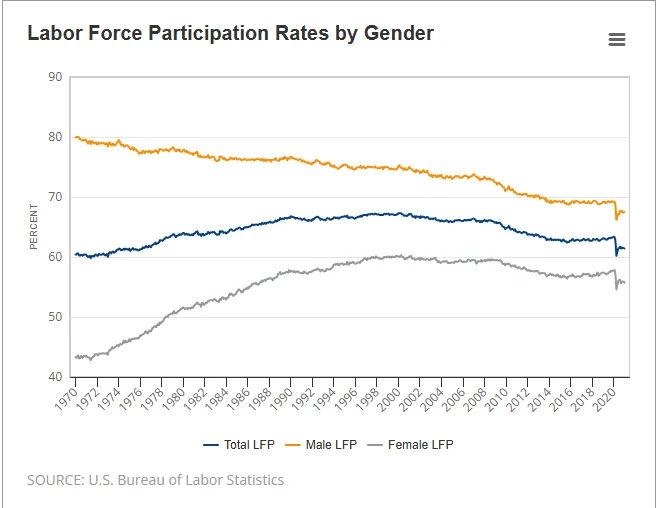
The current consensus narrative for why this is happening seems to go something like this:
- increased disability claims across the board
- younger men (e.g., <35 years old) are pursuing education instead of immediately joining the workforce
- a decline in manufacturing and an increase in services as fractions of the economy
Our economy shifted from labor that required physical toughness (manufacturing) to labor that required more intelligence (services). At the same time, our culture empowered women to attain more education and participate in labor markets. As a result, the market for jobs that require higher intelligence became more competitive, and many men could not keep up and became "inactive." A number of these men fell into depression or became physically ill, thus unable to rejoin the workforce.
I’m willing to bet that the adoption of AI agents in the workforce will lead to similar outcomes. AI agents are going to make jobs that require intelligence very, very competitive.
Another useful analogy: college admissions. I think starting a career is going to change in a similar way to how college admissions have changed in the last couple of decades.
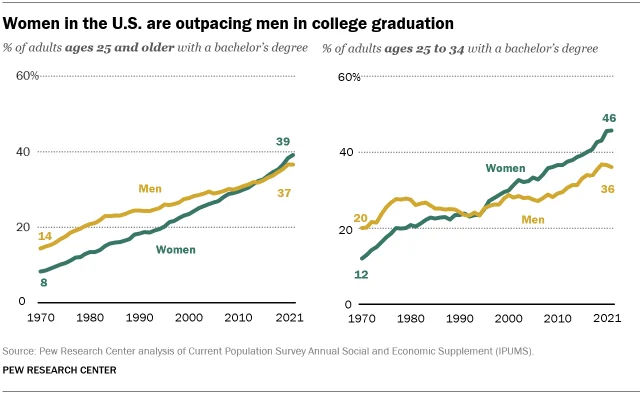
From about the 1940s to the 1970s, college admissions were a sexist and meritocratic process. Women were discouraged or barred from applying to higher education. However, the process for men was fairly straightforward — take the SAT (at the time, essentially an IQ test), and if you’re smart enough then you will be admitted.
From the 1970s to the 1990s, college admissions became less sexist, and were still fairly meritocratic. More women were finally encouraged or unbarred from attending university, while the SAT and other measures for college admissions remained the same.
Since the 1990s, however, the SAT has undergone several major reforms. Scores have been re-centered a few times and the questions have been re-worked. These changes made the SAT a weaker proxy for IQ, and we can see some of the knock-on effects today, such as many universities making the SAT optional and using other means to select applicants.
So, how do you decide which students to admit? Some combination of demographic information, GPA, test scores (for the students who choose to submit them), and lots of personal judgment.
How do students choose to stand out, if not through their test scores? By bending over backward and subjecting themselves to a battery of extracurriculars, living artificially crafted lives for their résumés. This is all in addition to getting perfect test scores and GPAs.
I can sum up my sentiment to all of the above trends in one sentence:
When intelligence is too cheap to meter, who cares for it anymore?